Doors Open Days on Foot: A Heritage Walker's Recovery Plan for Glasgow's Biggest Free Weekend
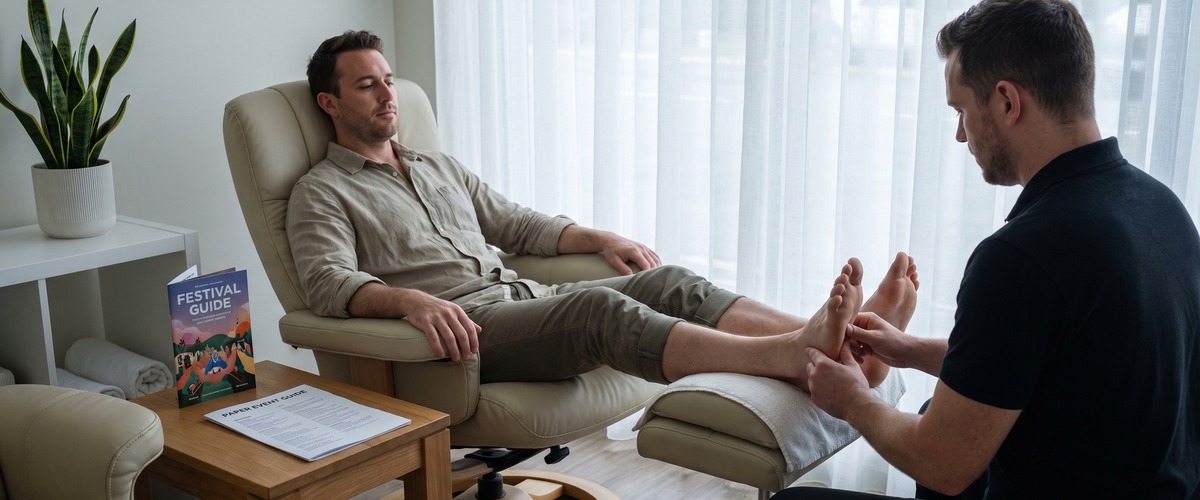
Four days of stair-climbing through Victorian buildings and standing on museum-hard floors is an endurance event, even though nobody treats it like one. Doors Open Days Glasgow, running 17 to 20 September 2026 with more than 150 free venues across the city, is one of the best free weekends the city offers. It’s also, if you’re doing it properly, one of the hardest things your feet will do all year.
Nobody trains for it the way they’d train for a hillwalk or a 10k. You just wake up on Saturday morning with a printed route plan and good intentions, and by Sunday evening your calves are asking questions you don’t have answers to. That’s the gap this piece is here to close: not another list of which buildings to see, but a plan for what to do with your body once you’ve seen them. If you already know your feet will need it, book your session today.
Doors Open Days Glasgow: why a walking weekend hits your feet harder than a marathon
A marathon is flat tarmac and a pair of well-worn trainers, all effort going in one direction over one day. A Doors Open Days weekend is something else entirely — stone stairwells, tiled entrance halls, standing still to take in what a guide is telling you, and then doing it all again the next day, and the day after that, with barely a chance to properly recover in between. It’s a completely different way of asking things of your body, and that difference is exactly what catches people out.
Buildings like the Mitchell Library, the Trades Hall of Glasgow, and the Merchants House weren’t built with tired feet in mind. Stone, marble, old timber — none of it gives the way a pavement does. Add in the spiral staircases and steep internal steps you find throughout Glasgow’s Victorian civic buildings, and you’ve got a weekend that quietly asks a great deal of the arch of your foot and the muscles running down your calf, which end up doing most of the work every time you take the stairs.
How many steps does a heritage walking weekend actually involve
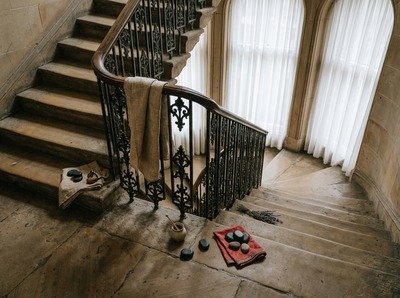
Most Doors Open Days regulars who track their steps report covering somewhere between 15,000 and 25,000 steps across the full weekend, often with several hundred flights of stairs mixed in depending on how many multi-storey venues are on the list. That’s not an extreme number on its own. What makes it different is the surface and the incline work, standing on hard floors for talks, then immediately tackling another stairwell, over and over, for four days running.
By Sunday evening, most people feel it first in the arch of the foot, then the calf, then a dull ache creeping up toward the knee. That’s not just tiredness — it’s the tell-tale sign of a foot and calf that have been working harder than usual. If that sounds like the Monday waiting for you, come in and let us give those muscles the attention they’ve earned.
Thai foot massage: the recovery tool built for exactly this kind of strain
This is the bit most Doors Open Days guides never mention. Thai foot massage is a reflexology-style treatment, working with focused thumb and knuckle pressure along particular points on the sole, arch and lower leg rather than a general rub-down. It’s designed to ease exactly the kind of tension a heritage walking weekend builds up in those areas.
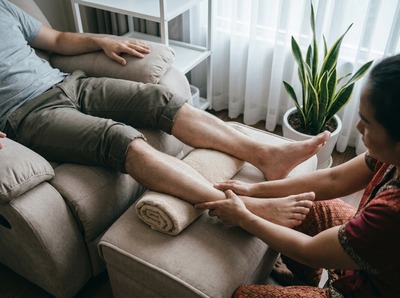
At Glasgow Thai Massage, Thai foot massage works methodically along the sole and up through the calf, targeting the plantar fascia and the muscles that absorb shock every time your foot lands on a hard stone step. It’s a completely different mechanism to a spa foot soak. The pressure is precise, not just soothing, and it reaches tissue that a warm bath never touches.
Jariya, one of our practitioners, has noticed that clients who arrive after a physically demanding day are often carrying tension they’re not even aware of. She’s seen how people who walk in stressed and wound tight tend to hold their breath without realising it, their whole body braced long before they sit down on the table. A weekend of stair-climbing and standing does much the same thing to the feet and calves — the tightness sets in well before the ache makes itself known.
How to recover after a day of walking through heritage buildings
The good news is that you don’t have to wait until the whole festival is behind you to do something about it. If Saturday was a long day, dealing with it Saturday evening puts you in a far better place than walking into Sunday already worn down.
- Elevate and stretch that same evening. Ten minutes with your feet up, followed by a gentle calf stretch against a wall, reduces the pooling and stiffness that builds up overnight.
- Book a session between festival days, not just after. A short Thai foot massage between Saturday and Sunday can noticeably change how the second day feels.
- Don’t ignore calf tightness because it’s “just the feet” that hurt. The calf muscles do most of the shock absorption on stairs, and tightness there often shows up as foot pain the next morning.
- Hydrate properly. Standing and walking on hard surfaces for hours dehydrates muscle tissue faster than most people expect, which makes next-day stiffness worse.
If there’s only one session worth booking, make it the one between your days out. That’s the detail a generic “wear comfy shoes” article always misses, because it assumes you’re out walking for one afternoon, not four days running.
What a Thai foot massage session actually addresses
A full Traditional Thai massage session, or a focused foot and lower leg treatment, works through the sole in sections, following the reflexology-style point map that Thai foot massage is built on. Combined with calf work, it addresses the two-part strain of stone floors and stairs together, rather than treating the foot in isolation.
According to the NHS guidance on plantar fasciitis, rest, stretching and reducing the load on the sole are key to easing this kind of strain, which lines up closely with what focused foot and calf work is designed to do. It’s not a medical treatment for a diagnosed condition, but the underlying logic, taking pressure off overworked tissue, is the same.
You can book a session online for either the Friday before the festival starts, if you know you’re prone to tight calves, or for the Monday after, when the accumulated strain of four days tends to peak. Either way, treating it as part of the weekend rather than an afterthought makes a real difference to how quickly you bounce back.
The takeaway for anyone doing Doors Open Days properly
Doors Open Days Glasgow rewards the people who go all in — several venues, several days, comfortable shoes, a proper plan. What most people don’t realise is that the plan shouldn’t end at the shoes. Stone stairwells and hard floors put a real, familiar strain on the feet and calves, and that kind of strain responds far better to focused, hands-on care than to an afternoon on the sofa.
Treat the weekend like the mini endurance event it actually is. Build in a recovery session, whether that’s between days or once the festival wraps up, and you’ll be walking normally on Monday instead of wincing your way down the office stairs. If you’re planning your route already, it’s worth exploring our services to see what fits your weekend, or head straight to book your appointment before the festival dates fill up the diary.
Sources:
- Everything you need to know about Doors Open Days 2026
- Glasgow Doors Open Days Festival
- Doors Open Days | Glasgow
Found this useful? Add blog.glasgowthaimassage.co.uk as a preferred source on Google so our latest guides show up first for you in Search and AI Overviews.