How Does Thai Massage Work: Sen Energy Lines and Pressure Points Explained
How Thai Massage Works: Sen Energy Lines and Pressure Points Explained
The most common assumption about Thai massage is that it works by moving you through a series of stretches until your muscles eventually loosen up. That framing captures roughly a third of what is actually happening.
Traditional Thai massage is built on a different physical model. Rather than targeting individual muscles, it works by stimulating a network of energy pathways called sen lines.
These ten routes carry lom pran — the body’s vital life force — from the centre to the limbs. Along each line sit acupressure points where blockages build up, causing tension, stiffness, or pain elsewhere in the body.
The stretch only arrives once those pathways have been prepared through sustained pressure. That sequencing is what makes Thai massage distinct from Western bodywork. It produces results that go well beyond loosened muscles.
If you want to experience this for yourself, you can book a Thai massage session at Glasgow Thai Massage on West Nile Street in Glasgow City Centre.
What Traditional Thai Bodywork Actually Does to the Body
A trained therapist follows the ten sen energy lines, pressing each acupressure point in turn before moving on. The tools are thumbs, palms, elbows, and sometimes feet — each suited to different depths and body areas.
This is not improvised. The route is methodical and follows each pathway from start to end.
The effect at each point is specific. Sustained pressure releases the tissue around it, restores circulation, and frees joints held tight by tension.
This is why results often show up in areas the client never mentioned. A sen line through a tense shoulder also runs through the neck, upper back, and down the arm. Clearing a blockage at one point changes conditions along the whole route.
Maliwan trained at Wat Pho Thai Massage School in Bangkok and has over twenty years of practice. She describes a client who arrived unable to turn her head more than a few degrees. The client had spent fifteen years at a desk, not noticing how restricted she had become.
After one session on the sen lines through her neck and upper back, she could move freely again. She was visibly moved at getting something so basic back. That result came not from stretching her neck, but from clearing blockages built up over years.
The assisted stretches that follow the acupressure feel different to stretches applied cold. Tissue prepared this way releases more fully, for longer, and with far less resistance.
Experienced practitioners treat the acupressure as the main work. The stretching that follows is its natural completion, not the other way around.
How Sen Lines Release Tension: What Happens in a Session
You remain fully clothed throughout a Traditional Thai Massage. Loose, comfortable clothing is all you need.
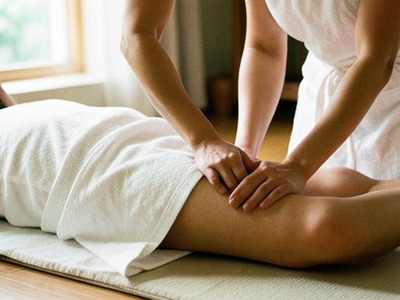
The therapist works on a mat, using body weight to apply pressure from the feet up. They move through the sen lines in order, not just where it hurts most.
Thai massage and oil-based massage are not the same thing. Without oil, the therapist can engage the sen lines directly and hold precise contact at each acupressure point.
Oil changes how that contact feels entirely. That is why our traditional and oil-based treatments are genuinely different experiences, not the same session done two ways.
Jariya practises alongside Maliwan at Glasgow Thai Massage. She has noticed that clients who arrive tense are almost always holding their breath without knowing it. By midway through a session, their breathing has usually settled — and when she points it out, they are always surprised.
That shift does not happen because someone pulled their shoulders back. It happens because the sen line tension has begun to release, and the body responds.
Why Thai Massage Produces Different Results to Other Approaches
The question that comes up is whether this is just deep tissue massage with stretching added. The method is genuinely different, and that matters when choosing the right treatment for a specific problem.
Deep tissue massage works across muscle fibres, pressing directly on specific muscle layers. It is effective and targeted. Thai massage works along lines that cross multiple muscle groups, joints, and tissue at the same time.
Because it treats the whole pathway, it reaches tension patterns that local treatment often misses. Think of the tight hip driving a shoulder problem, or the posture shift that keeps loading the same knee.
The common logic with persistent pain is: find the sore spot, work on it directly. We see clients who’ve done exactly that for years without lasting change. Thai massage takes the opposite approach — clear the pathway feeding the problem, and the painful spot often resolves without ever being touched directly.
In our experience, this shows up most often with people who work long hours at a desk — a pattern common enough in Glasgow city centre that we see it almost every week. The shoulder is the complaint. But the sen line feeding it runs from the hip. That is where the session starts.
Thai sports massage applies the same sen line principles to recovery, range of motion, and injury prevention. Clients who kept hitting the same issue elsewhere often find the sen line method brings lasting change. It gets back to where the problem started, not just where it hurts now.
Clients who have tried both Thai technique and oil work describe it well. One reviewer noted that “the combination of deep tissue oil massage and Thai massage is very good.” The reason is simple: they reach different layers of the same problem, not the same layer twice.
A final note worth making directly. Glasgow has good reasons for scepticism about massage businesses. Knowing the difference between a genuine therapeutic practice and something else is a fair concern in the city centre.
Glasgow Thai Massage is a studio run by Maliwan and Jariya, both trained in the Wat Pho tradition. Their work is clinical in intent and grounded in real technique. The results clients report — pain relief, restored movement, and genuine rest — follow directly from the method described here.
Book your appointment online and see what working along the sen lines produces in practice.