Thai Massage for Flexibility: Why Your Gains Won't Last Without Strength Work
Thai Massage for Flexibility: What It Actually Does to Your Range of Motion
Thai massage increases flexibility by combining assisted stretching, acupressure, and joint mobilisation along the body’s sen energy lines, a network of pathways traditional Thai practice works to clear of restriction. What most articles on this topic leave out is the catch: those gains plateau, and then quietly reverse, unless you build the muscular strength to hold your body in its new range. One session can loosen a shoulder that’s been locked for a decade. Keeping it loose is a different job entirely.
At Glasgow Thai Massage, we see this pattern all the time. Clients across the city centre book Thai massage for flexibility.
Someone arrives after years of tight hamstrings. They leave able to reach past their knees for the first time. Then the old stiffness creeps back within a month.
That’s not the massage failing. It’s what happens to any soft tissue change that isn’t backed up by strength.
Assisted Stretching vs Static Stretching for Flexibility Gains
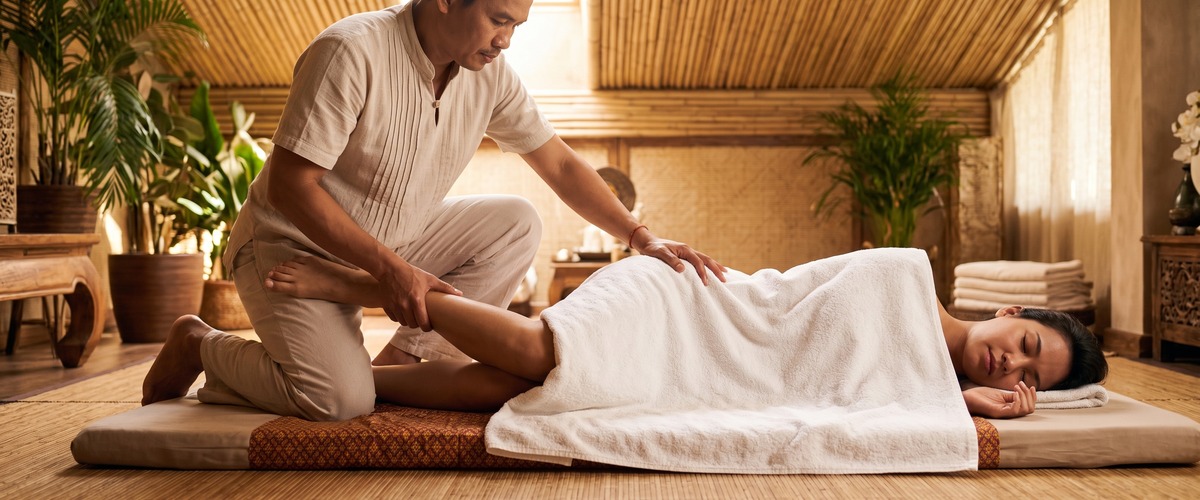
Assisted stretching is the real difference between Thai massage and stretching on your own mat at home. Your therapist moves your limbs through ranges you can’t reach alone.
Your own nervous system won’t let you push past a point it reads as unsafe. When someone else guides the stretch and reads your body’s resistance, that safety limit shifts.
Maliwan, founder of Glasgow Thai Massage, sees this most clearly with desk workers. She recalls one client who couldn’t turn her head more than a few degrees. Fifteen years at a desk had locked her up, and she hadn’t even noticed.
After the first session, she could move her neck freely again. She cried a little, because she’d forgotten what that felt like.
That kind of shift can happen in a single hour, whether it’s shoulders, hips, or hamstrings. It’s also why some people arrive nervous.
One Reddit thread on r/massage caught this well. Someone asked whether Thai massage would be “too intense” for a partner who was “very stiff” and prone to sore muscles.
If that sounds like you, book your session today and tell us what feels tight. We match the pressure to you, not the other way round.
The honest answer: Thai massage can feel intense. But that intensity comes from reaching tissue guarded for years, not from brute force.
You stay fully clothed throughout. The pressure is matched to what you can handle.
Client reviews of the studio often note that sessions are “done to the pressure requested.” That’s the whole point of a therapist who checks in rather than pushes through.
Why Flexibility Plateaus Without Strength Training
Flexibility from Thai massage releases restriction. It doesn’t rebuild the strength that stops the restriction forming in the first place. That gap is where most flexibility routines quietly stall.
Jariya, who practises alongside Maliwan, put it plainly. She’d worked with a client who had already seen several sports massage therapists.
The client kept re-injuring the same spot. Jariya mapped how her left hip was pulling her whole posture forward.
The problem wasn’t the sore point itself. It was the muscles around it, working overtime for something weaker nearby.
That’s the mechanism behind the plateau. A muscle is often tight because a nearby muscle is too weak to do its job. So the tight one overworks to cover for it.
Stretch or massage the tight muscle but leave the weak one alone, and you’ll get a few good weeks. Then the same restriction rebuilds. The underlying imbalance never changed.
This is where deep tissue massage earns a place alongside flexibility work. It’s an oil-based technique that works deeper into the muscle layers than Thai massage’s clothed stretching.
It can target the exact tension holding a joint back, rather than the whole-body release Thai massage gives. Our deep tissue massage guide explains how that targeted work fits a flexibility routine.
Either way, pair it with basic strength exercises for the muscles on each side of your tightest joint. That’s what gives the new range something to hold onto.
How Often Should You Get Thai Massage for Flexibility?
For chronic tightness, weekly or fortnightly sessions work best. They give your body enough consistency to keep extending its range before it snaps back.
Once you’re happy with your flexibility, monthly sessions are usually enough to hold it. That’s provided you do some strength or mobility work of your own between visits.
Athletes and cyclists riding Glasgow’s busy commuter routes often add Thai sports massage. It’s a treatment built around recovery and injury prevention for active clients.
Time it around your training blocks, rather than waiting until something tightens up. Got tight hamstrings or a stiff shoulder? Say so when you book a session online, and we’ll build the treatment around it.
You don’t need to guess which mix suits you. We’ll talk through what’s really limiting your movement first. Then we’ll decide together: a traditional Thai massage, a sports-focused session, or a bit of both.
Thai massage for flexibility isn’t a myth, and it isn’t a gimmick. The reviews show real, fast gains in range of motion after just one or two sessions. But on its own, it isn’t a permanent fix.
Think of it as the half that opens the door. Strength work is what keeps the door open.
Pair the two, and the flexibility you gain on the mat starts to stick around instead of fading by next month. Explore our full range of treatments to see which combination fits. Or book your appointment now and tell us what you’re trying to loosen up.
Found this useful? Add blog.glasgowthaimassage.co.uk as a preferred source on Google so our latest guides show up first for you in Search and AI Overviews.