Thai Massage vs Deep Tissue Massage: Which One Fixes Your Problem
Thai Massage vs Deep Tissue Massage: Two Different Jobs
Thai massage and deep tissue massage are not two strengths of the same treatment, they solve two different problems. Thai massage uses passive stretching and acupressure to restore mobility and range of motion, while deep tissue massage uses sustained, direct pressure to break up muscle knots and adhesions in specific areas. Most comparisons rank the two by how hard you like to be pressed on, which misses the point entirely.
At Glasgow Thai Massage, this is the question we hear most from clients who’ve tried one but never the other, usually assuming whichever they haven’t had must be the “stronger” version. It isn’t. A desk worker with a locked-up neck needs something different from a runner with tight hip flexors restricting her stride, even if both describe the same feeling as “tight.”
How Traditional Thai Massage Restores Mobility
Traditional Thai massage is performed fully clothed on a floor mat. Instead of oil and direct pressure, the therapist uses their own body weight to guide you through assisted stretches, combined with acupressure along the sen energy lines, a network of pathways Thai tradition maps across the body. The result feels less like a rubdown and more like a thorough, entirely passive stretch class someone else is doing for you.
That distinction shows up in the research. A study of 24 collegiate volleyball players published in the Journal of Foot and Ankle Research found Thai massage produced statistically significant improvements in knee and ankle range of motion, plus vertical jump performance, compared with a control group. Stretching under someone else’s control appears to unlock range of motion your body won’t give up on its own.
Maliwan, who founded Glasgow Thai Massage after training at Wat Pho in Bangkok, has watched this play out directly. One client arrived so tight through the shoulders she couldn’t turn her head more than a few degrees, having spent fifteen years at a desk without realising how locked up she’d become.
After a single session, she could move her neck freely again, and it caught her off guard enough that she teared up in the treatment room. That’s mobility work doing the job, not muscle work.
If tightness is limiting how far you can turn, bend, or reach rather than aching in one fixed spot, book a session online and mention what feels restricted so your therapist can focus the stretching where it counts.
How Deep Tissue Massage Releases Muscle Knots
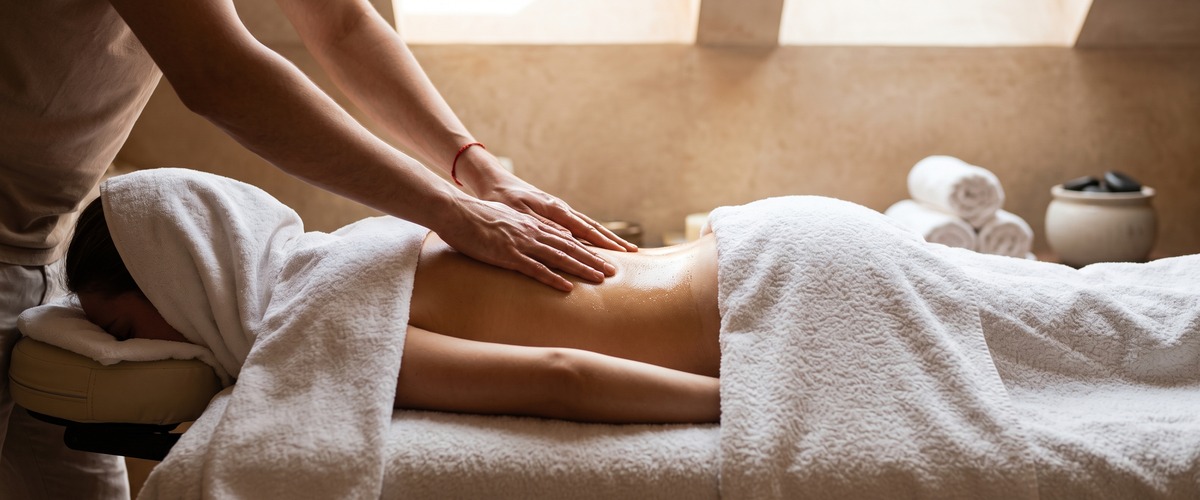
Deep tissue massage works the opposite way. It’s oil-based, and the therapist applies slow, sustained pressure into the deeper layers of muscle and connective tissue, working directly into the trigger points and adhesions that build up from repetitive strain, old injuries, or months of poor posture.
There’s no stretching sequence involved. The pressure itself is the treatment.
The evidence for this is measurable. In a prospective randomised trial of 59 patients with chronic lower back pain, deep tissue massage alone reduced pain scores by roughly 28% over the course of treatment. That’s a specific muscular problem responding to specific muscular pressure, a different mechanism entirely from the mobility gains Thai massage produces.
We’ve written before about how deep tissue massage transforms your body and mind, and the short version holds here. If you can point to the exact spot that’s tight, whether that’s a knot between your shoulder blades or a locked-up lower back from a desk job, deep tissue massage is built to find it and work it loose directly.
Which Treatment Should You Actually Book
The honest answer to “which is more effective” depends entirely on what you’re dealing with. Sciatica and frozen shoulder tend to respond better to Thai massage’s assisted stretching, because the problem is restricted movement through a joint or nerve pathway rather than one tight muscle. A knot between the shoulder blades from twelve hours in front of two monitors usually responds faster to deep tissue’s direct pressure instead.
Sports recovery sits somewhere in between, which is why we treat Thai sports massage as its own thing rather than a stronger deep tissue session. It’s built around targeted recovery and injury prevention for people training regularly, not just working out a single sore muscle after the fact.
Jariya has seen how easy it is to misdiagnose which one you actually need. One client had been through several sports massage therapists for the same recurring injury before working with her.
Once Jariya mapped out where the client’s body was compensating, tracing how a pulled left hip was dragging her whole posture forward, it became clear the sore spot wasn’t the real problem. Sometimes what looks like a deep tissue case is really a mobility case wearing a knot as a symptom.
When the Two Work Better Together
Plenty of our regulars don’t pick one and stick with it. One of the most consistent patterns in client feedback is people who alternate between the two, or ask for a session blending both. One recent review put it simply: the combination of deep tissue oil massage and Thai massage “is very good,” because the stretching opens the joint and the pressure clears the knot sitting underneath it.
Glasgow’s weather plays a part too. City centre appointment patterns shift with the seasons.
Deep tissue bookings climb whenever the damp, cold weather sets in and clients arrive hunched forward against the wind with locked-up backs and shoulders, while Thai massage tends to get booked around gift vouchers and quieter weeks when people want something closer to a full reset. Neither pattern is wrong, they’re just answering different questions.
If you’re not sure which side of that line you’re on, book your appointment and tell us what’s bothering you rather than which treatment name you’ve heard. We’ll steer you toward whichever one actually matches the problem. Sometimes that’s both.
Thai massage and deep tissue massage were never competing for the same job. One restores how far your body can move, the other releases what’s stuck inside a specific muscle, and the real skill is recognising which one your body is actually asking for before you book either.
Found this useful? Add blog.glasgowthaimassage.co.uk as a preferred source on Google so our latest guides show up first for you in Search and AI Overviews.