The Active Lifestyle Guide: Injury Prevention and Recovery Through Massage
Injury Prevention Through Massage: The Performance Edge Most Active People Are Missing
Most active people treat massage as something they book after things go wrong, not as part of an injury prevention routine. A hamstring that will not settle. A shoulder that keeps clicking. A lower back that has finally run out of patience after months of being ignored. That is understandable. It is also the reactive loop that keeps people cycling through the same injuries on roughly the same schedule.
The athletes who rarely get hurt are not just lucky. They treat massage as part of how they train and recover — not a last resort. That link between preventative massage, flexibility, and performance is where this guide starts.
Glasgow Thai Massage works with active clients across all disciplines — runners, cyclists, gym regulars, climbers, and team sport players. The pattern we see in those who stay injury-free is consistent: treat the body as a system that needs upkeep, not a machine that only gets attention when it breaks. Book a session online if you want to start from that different place.
The Compensation Problem Nobody Talks About
When something is restricted in your body, everything around it compensates. Your hip flexors tighten, so your lower back takes the load. One shoulder sits slightly higher, pulling your upper chain off.
The common advice is to work on whatever hurts. But the pain is rarely where the problem started — it is just where it ended up. Your tweaking knee often traces back to how your right hip is moving, not the knee itself.
Maliwan, the practitioner at Glasgow Thai Massage, sees this pattern regularly. “I worked with a client who had been to several therapists but kept getting injured in the same way. Once I mapped out where her body was compensating — how her left hip was pulling her whole posture forward — she understood it wasn’t just about treating the sore spot.”
Treating the symptom stops the pain. Addressing the compensation is what stops it coming back. Thai sports massage takes a full-body view of movement and tension — well suited to spotting these whole-system patterns rather than just working on whatever hurts most.
Why Improved Flexibility Changes Your Risk Profile
Improved flexibility is one of the clearest ways to cut injury risk. When range of motion is limited, joints and soft tissue are pushed through tight planes. When training demands more than that range allows, something gives.
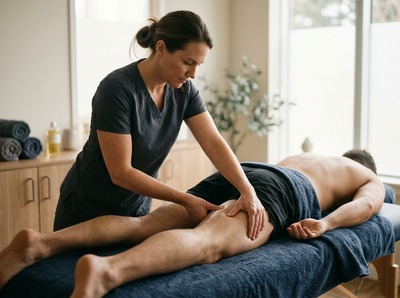
A systematic review published on PubMed found that sports massage leads to real, measurable gains in flexibility. The gains are modest in any single session. But they build with regular treatment, and that consistency is what matters when you train the same patterns week after week.
Traditional Thai massage is especially useful here. Assisted stretching on a mat takes each joint through its full range, guided by a trained practitioner. For a runner with shortening hip flexors, or a cyclist whose upper back never fully extends, this is the input that training alone cannot provide.
Sports Recovery Massage: What the Research Actually Shows
A 2025 trial followed 150 athletes receiving twice-weekly deep tissue massage over eight weeks. It found clear improvements in recovery, flexibility, and performance — with the biggest gains in strength and team sport athletes. Key areas like the lumbar spine, knees, and shoulders showed measurable flexibility gains and faster recovery between sessions.
Massage works best as part of a broader approach, not a standalone fix. It helps clear metabolic waste, reduce tension, and improve blood flow to tissues that heavy training has stressed. The result is that your next session starts from a better baseline.
Deep tissue massage targets the deeper layers of muscle and connective tissue with sustained pressure. It reaches the chronic build-up that standard cool-downs never quite clear.
Glutes, hip flexors, and the thoracic spine are typical targets for active people. Glasgow Thai Massage incorporates deep tissue work into sports sessions where it suits the client’s training load and history.
Stress, Tension and the Training Load Nobody Measures
Here is what most fitness guides miss: stress and muscle tension count as training load too. A heavy week at work, poor sleep, or sustained pressure all raise cortisol and keep the nervous system on alert. Muscles stop releasing fully, recovery slows, and the session that would normally leave you fine starts tipping toward injury.
Maliwan, Glasgow Thai Massage’s founder with over 20 years of practice, has seen this many times. “In our experience, it’s not always the hardest sessions that break people down,” she says. “It’s the hard sessions stacked on top of a hard week. We see a lot of Glasgow runners and cyclists come in around March — they’ve trained outdoors through the whole winter, and by then the body is carrying months of accumulated load with no real reset in between.” One regular client described her session as the only appointment she never cancels — the hour on the mat being the only time her mind truly stops. That kind of reset changes how the body handles training load, not just that day but in the weeks that follow.
How Massage Prevents Sports Injuries: Timing Your Sessions
The practical question is where massage fits into a training week. Injury prevention through massage is less about how often you go than about timing and intent.
For athletes in a heavy training phase, fortnightly sessions work well — with an extra one if something starts pulling tight. The aim is to catch compensations before they become problems. For people in a general fitness routine, monthly maintenance is usually enough, focused on whatever area is under most load.
The common mistake is waiting for pain before booking. By the time pain arrives, the restriction has usually been building for weeks. The body compensated well enough to hide it — until it ran out of options.
One or two earlier sessions would have caught it. For more on how recovery works between sessions, this piece on massage for recovery and healing is worth reading alongside this guide.
Book your session at Glasgow Thai Massage and let us know what you are training for. Sessions are tailored to your current phase and the specific demands of your sport or activity. The investment in prevention costs far less — in time, money, and weeks lost — than starting from scratch after an injury that earlier work might have stopped altogether.